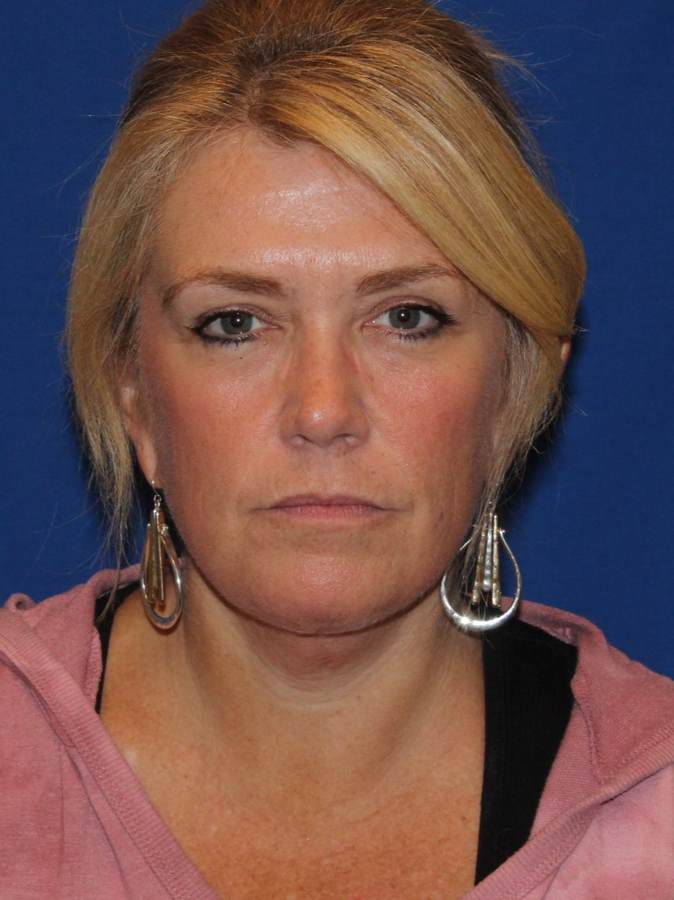
A focused approach that directly addresses a heavy or hanging neck.
Some patients remain satisfied with their face, jawline, and lower facial contours but are troubled by pronounced neck laxity that is often hereditary. For this specific group, direct submentoplasty provides a focused alternative to a comprehensive face and neck lift. The procedure directly treats excess skin, unwanted submental fat when present, platysmal laxity, and deeper muscular structures that contribute to the neck’s shape. Because the operation is more limited in scope and generally shorter, selected patients may be able to undergo it with lighter sedation.
Advanced cervical skin laxity may produce a dependent fold extending from the submental region toward the lower neck. Conventional face and neck lifting treats this tissue indirectly by redraping it laterally toward periauricular incisions. Direct submentoplasty uses an anterior cervical approach to excise the redundant skin at its point of greatest excess. This can achieve a powerful correction in appropriately selected patients with isolated neck laxity and minimal lower-facial aging.
Submental fullness reflects the combined influence of superficial fat, deeper soft tissue, tissue thickness, and the underlying neck framework. These components affect both the apparent weight of the neck and the definition of the cervicomental angle. Direct visualization allows selective reduction and contouring of the contributing tissues rather than relying exclusively on indirect repositioning. The objective is a cleaner transition beneath the chin while preserving sufficient soft-tissue coverage for a smooth, natural contour.
Platysmal separation and laxity can create vertical banding, anterior neck fullness, and loss of definition between the chin and neck. Through the direct approach, the platysma can be fully visualized, mobilized, and anchored under controlled tension. When the deeper muscular floor also contributes to the contour, it can be evaluated and selectively adjusted under direct exposure. Treating these layers together can improve the neck angle while providing durable structural support.
The wider access provided by direct submentoplasty comes with an important tradeoff: the incision is located on the front of the neck. Z-plasty can interrupt the vertical line, distribute tension more favorably, and reduce contraction, but the scar is inherently less concealed than the carefully positioned incisions around the ear used in a traditional face and neck lift. In selected patients with a very heavy neck, an existing vertical fold may help camouflage its placement. The scar is also often easier to disguise in men with textured skin, established creases, or beard growth, while it may remain more noticeable in patients with smooth anterior-neck skin.
Expected early findings include edema, bruising, incisional numbness, and a sensation of tightness; substantial pain is uncommon. Head elevation is maintained, and the cervical spine should remain in a comfortable neutral position. Although formal immobilization is unnecessary, excessive flexion, extension, and rotation should be avoided. The compression dressing remains in place according to protocol and is evaluated at the first postoperative appointment, generally the following day.
The first week emphasizes incision management, compression, nutrition, hydration, and protection of the surgical repair. Wound care is performed according to the technique demonstrated during postoperative visits. Patients should avoid lifting, bending, exertion, and unnecessary movement of the neck. Most sutures are removed at approximately one week when the incision demonstrates appropriate early healing.
Edema and ecchymosis should progressively improve, while residual numbness, firmness, and mild asymmetry may persist. Restrictions on strenuous activity, lifting, bending, and forceful neck rotation continue through the second week. Ambulation and light household activity are encouraged within reasonable limits; bed rest is neither required nor desirable. Patients whose work can be performed remotely may resume computer, telephone, or administrative duties before they are comfortable returning to in-person professional settings.
The soft tissues continue to settle as residual swelling and submental firmness diminish. Physical activity is advanced gradually according to healing and clinical evaluation. Incisional redness, firmness, or early contraction may become more apparent during this stage. Scar-management recommendations are individualized during follow-up examinations.
Scar redness and firmness may be most apparent during the first one to two months. The incision should subsequently begin a prolonged process of softening, flattening, and fading. Continued improvement in swelling and tissue definition is expected. Complete scar maturation generally extends over six to twelve months and occasionally longer.
Scar contraction or localized tightness may occur during the remodeling phase, particularly along the anterior neck. Appropriate treatment may include directed stretching, manual scar mobilization, lymphatic drainage, professionally administered therapeutic massage, or intermittent compression. These measures are recommended selectively according to the examination. Tissue mobility, sensation, scar color, and the final neck contour continue to improve throughout this period.
Our private surgical suite in Syracuse has maintained AAAHC accreditation for more than a decade. AAAHC accreditation involves independent, recurring review against nationally recognized standards for patient safety, clinical quality, infection prevention, emergency preparedness, and continuous quality improvement. Maintaining that accreditation is an ongoing commitment rather than a one-time designation. Through experience, rigorous protocols, and continual review, Dr. Kim and his team strive to provide every patient with a consistently high standard of safety and care.
The suite supports an individualized spectrum of anesthesia, ranging from local anesthesia with an oral sedative to twilight sedation and deep sedation. Direct submentoplasty generally involves a more limited surgical field and shorter operative duration than a traditional face and neck lift; for carefully selected patients, it may therefore be performed under twilight sedation, while a traditional face and neck lift is typically performed under deep sedation. The appropriate level is selected according to the planned procedure, the patient’s health, and the degree of comfort and monitoring required. Because facial, head, and neck surgery is the sole focus of the practice—and the suite is dedicated to one surgeon—its staff, equipment, protocols, and recovery environment are purposefully organized around the operations Dr. Kim performs. This focused private setting gives the team direct oversight of quality and supports transparent, sensible control of facility costs, with the anesthesia plan reviewed in detail during consultation.
The cost of surgery reflects three components: the surgeon’s fee, the facility fee, and the anesthesia fee. These vary with the extent of correction, anticipated operative time, and anesthesia plan. Following consultation, each patient receives a complete and itemized financial proposal based on the procedure developed for them. Direct submentoplasty and neck lift surgery are elective and self-pay.
Although direct submentoplasty focuses specifically on the neck, some patients wish to address other facial changes during the same surgical experience. Facial fat transfer can restore areas of volume loss, and upper or lower eyelid surgery can improve heaviness, hooding, or under-eye fullness. Laser resurfacing may be concentrated around the mouth to refine fine lines and texture or applied to the full face for more comprehensive skin rejuvenation.
There is no dedicated study of neck lift longevity, so any number is experience rather than data. Pooled band recurrence was 1.4 percent with short follow-up, and facelift series put a second procedure at nine to eleven years. Expect many good years, not a permanent fix.
Surgery on the platysma, the thin sheet of muscle covering the front of the neck, whose halves separate in the midline with age and show as vertical bands. A midline (corset) platysmaplasty rejoins the edges through a small incision under the chin; a lateral platysmaplasty tightens the muscle sideways. Many necks need both.
Our protocol asks for at least one week of rest from work, and most patients feel presentable in the second or third week. Deep swelling under the chin takes months to settle. These timelines are our patients' experience, not published data.
A deep neck lift goes beneath the platysma. Opening the muscle exposes the subplatysmal fat, the paired anterior digastric muscles and the superficial lobe of the submandibular gland, and conservative reduction sharpens the chin to neck angle in a way skin tightening cannot. It suits a specific anatomy, and it adds risk.
A neck lift changes the neck; a facelift changes the cheek and jawline and usually the neck as well. A jowl is a cheek problem, so a neck operation sharpens the line behind it without repositioning it. If pulling the neck skin back toward the ears gives the line wanted, a neck operation may be enough.
The published answer is reassuring: in 452 neck lift patients, adding anterior digastric myectomy did not increase difficulty swallowing, altered speech or throat pain, and the larynx itself is never entered. Temporary throat tightness while swelling settles is common; lasting voice change is not a described outcome.
Our written post-operative instructions do not describe a drain, so this answer rests on the published literature: a Level One randomized trial of 160 patients found no significant difference in hematoma, seroma or swelling between a hemostatic net and a surgical drain, and a meta-analysis of 8,841 patients found no clearly superior method.
Cobra neck is a hollow under the chin flanked by fullness on either side, following over-resection of the midline fat with the lateral neck left untouched. It is hard to correct afterward, usually needing fat grafted back in, which is why conservative midline resection matters.
Some do, and the published rate understates it: the pooled 1.4 percent across 2,106 patients came with a call for longer reporting, and recurrent banding is the most frequently cited reason for revision. A band returning early usually means it was released but not secured, or deeper fullness was never addressed.
It can improve contour in selected patients, and long term data does not exist. Nerve injury was 3.97 percent, sialocele 1.33 percent and prolonged firmness 21.43 percent across 3,379 patients, 1,651 with resection; dry mouth was reported at 0.13 percent, but no study used a validated instrument or went past six months.
Age alone is not the limit: the mean age in the office based local anesthesia series was 63.5 years, and these operations are routinely performed into the late seventies. Medical fitness, blood pressure control, nicotine use and skin quality matter more, and older skin more often needs removing than redraping.
Tightness is worst in the first day or two, eases from the second week, and is mostly gone by around three months. Numbness under the chin and along the jawline typically takes six to twelve weeks, and odd patches can persist to six months.
Not in the first two weeks, and after that nobody knows whether it helps; no validated stretching protocol exists after neck lift. Practice protocol, not evidence: our sheet asks patients to avoid activities that require turning the neck for at least two weeks, because a fresh midline muscle repair needs time to hold, and regular physical activity resumes in week three unless Dr. Kim says otherwise. We offer no stretching program.
Usually. Firmness is close to universal once swelling recedes, from buried suture knots, fat that did not survive, or healing fibrosis, and most of it settles over three to twelve months. Call early about a lump on one side only that is getting bigger, anything tender, hot or red, or a swelling that changes when you eat.
Cambiaso-Daniel J, et al. Neck lift with platysma transection. Facial Plastic Surgery, 2025.
Girão YRG, et al. Submental liposuction adverse events. J Oral Maxillofac Surg, 2026.
Gray AJ, Starkman SJ. Anterior digastric myectomy. Facial Plast Surg Aesthet Med, 2026.
Morel SBA, et al. Submandibular gland reduction. Aesthetic Surgery Journal, 2025.
Pak KY, et al. AAFPRS neck lift survey. J Craniofac Surg, 2026.
Şibar S, et al. Revision neck lift review. Aesthetic Plastic Surgery, 2026.
Fiore G, et al. Open versus closed neck lift, FACE-Q. Aesthet Surg J Open Forum, 2026.
Ismail M, Ghoraba S. Hemostatic net versus drain. Aesthetic Plast Surg, 2025.
Sherif R, et al. Platysmal banding and recurrence. Plast Reconstr Surg, 2026.
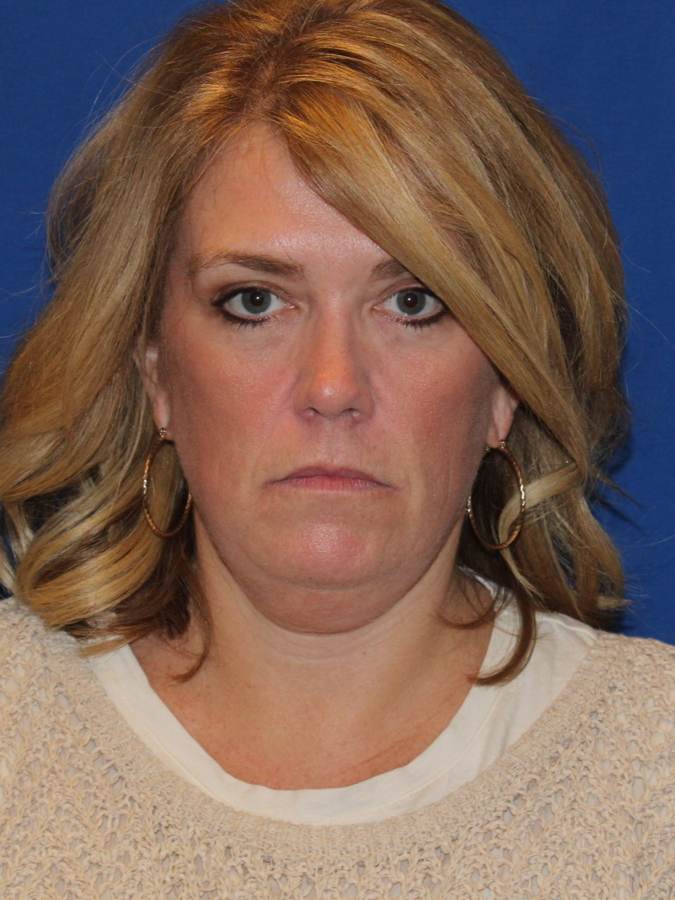
Shown with patient consent. Individual results vary by anatomy, technique, and healing.
View More Neck Lift / Submentoplasty Results in the Full Gallery →
This page is provided for education and is not medical advice. Reading it does not create a physician–patient relationship. No result shown or described is a guarantee; individual results vary by anatomy, technique and healing, and every surgical decision should be made in consultation with a qualified surgeon who has examined you.
Patients from New York City stay at our guest house in Syracuse for about two weeks, which covers the one-week and two-week follow-up visits, and return home afterward. Patients from Rochester stay at a local hotel the first night and then return home, and they return to Syracuse for their follow-up visits.
4939 Brittonfield Pkwy, Bldg B, Ste 208, East Syracuse, NY 13057. Main office and location of the accredited surgical suite. 315-471-8404.
Syracuse Office →70 East Boulevard, Rochester, NY 14610. Consultation and follow-up office, with a travel program for surgical patients.
Rochester Office →347 E 53rd St, Suite Lobby A, New York, NY 10022. Consultation and follow-up office for NYC patients. 929-291-0922.
Manhattan Office →"63 Year Old...wanted a Neck Lift — Dr. Kim and his staff were amazing...TRULY! So helpful, professional, caring and competent! Recovery went very well; it was about one week before I went back to work but I was out and about in 4 days."
"His face and neck lift were flawless and so natural that no one could tell I had anything done, but everyone said I looked ten years younger. I think he is the best facial plastic surgeon in the country."
"At 63 years old having a facelift and necklift surgery was a huge decision to make. Dr. Kim was very professional and explained everything in detail. I felt very comfortable there."